
Content migration & user research for a leading medical research institute
Simon turns demanding stakeholders into champions for him and the project. As well as being an outstanding content strategist and project manager, he is an all-round good egg and a person who makes you look forward to going to work.
—Tim Edwards, Digital Experience Manager, Burnet Institute
Client
Burnet Institute
Services
Content migration, content redevelopment, project management, user research
Task
Simon (trading as Agents of Content) was contracted by the Burnet Institute, one of Australia’s leading medical research and public health institutes, to perform two important roles. The first role was managing their website content migration project. The second role was conducting user testing on newly migrated pages and templates.
These roles were part of a broad initiative to improve the user experience and design of the Burnet website.
Content migration
In collaboration with Burnet’s Digital Experience team, Simon was responsible for the migration of content formats from Burnet’s old website structure into a new version that included new page templates, content, UX components and information architecture (IA). He worked with key formats including blog posts, home page modules, project pages, researcher pages, information resources (PDFs, podcasts and videos), student information pages and newsletters (converted to html from eDM).
Simon’s work included:
- Cloning the old website by mapping existing pages and components with their new equivalents and uploading them to the Umbraco content management system.
- Checking the integrity of components and pages, confirming their place in new IA, and modifying, reworking or archiving where necessary. This included applying design thinking to the task, such as determining the ideal user experience and user journey of the new components.
- Collaborating with Burnet stakeholders and subject-matter experts to source and create new content for new templates.
- Checking the accessibility, integrity, SEO and metadata of all pages, including automatically migrated pages.
- Performing quality assurance of the new website structure and content including formatting, link integrity, image quality, page structure and IA hierarchy.
- Assessing new content against the Burnet brand guide, style manual and project style sheet.
- Project-managing migrated pages, maintaining accurate, ongoing logs, timelines and migration records in SharePoint, Google Sheets, Excel and Monday.
User testing
With the content migration component completed, Simon conducted user interviews that tested flagship features of the new site. These interviews asked representatives of Burnet’s key audiences to find certain features on the new site and to supply their overall impressions of the site.
His work included:
- Developing a user testing plan and user interview script.
- Conducting six forty-five-minute user interviews.
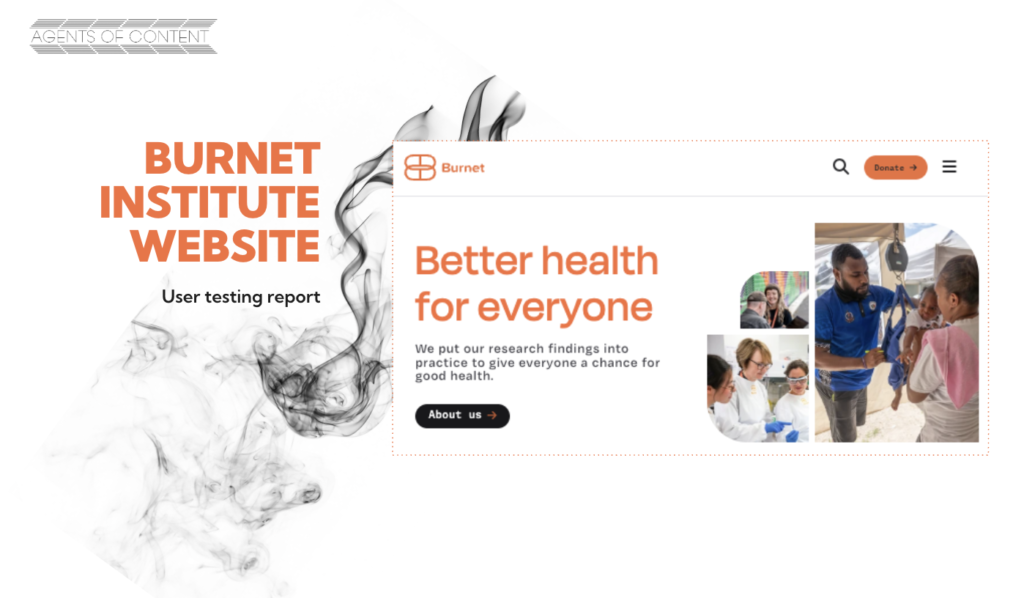
- Developing a user-testing report that included overall findings, specific results of key site enhancements and recommendations for future improvements.
During the interviews, conducted online, Simon asked users to visit the Burnet home page and share their screens. He then gave them a series of tasks to access the site. Simon observed their progress via the shared screen, asking the users about their overall experience of the new site and any recommendations they might have. The aim was to assess if users could complete key tasks efficiently and confidently and if the new site improves comprehension and builds trust in Burnet.
Results
Content migration
Burnet’s content migration project was completed on time and with a high degree of stakeholder satisfaction. Sometimes, stakeholders had different expectations as they were unfamiliar with some of the new templates. However, Simon was proactive in arranging stakeholder meetings, carefully explaining the function and flexibility of the incoming components. especially their enhanced ability to showcase the work of Burnet and its expert research staff through rich media and other feature modules.
User testing
The user testing delivered valuable firsthand experience that gave the Digital Experience team valuable insights on how the new website was performing. Simon delivered the results in a visual report that clearly and concisely summarised interview findings and supplied recommendations for future improvements.
Results and recommendations covered UX labels and wayfinding, home page structure, the visibility of researcher profile pages, the accessibility of content and the complexity of the information architecture.
Simon weighed these results against recommendations from the original round of user testing that led to the website improvement project (before he came on board). In this way, he was able to easily explain to the team how the website improvement project was tracking since it was first conceived.